The history of Engraved Firearms

Follow the evolution of Engraving on Firearms
While there is evidence that the first records of engraving go back many centuries, the term 'Engraved Firearm' today is a description loosely used to describe a pattern permanently marked on a gun usually by some form of depression in the surface..
Early forms of engraving on firearms and swords were crude lines cut into the metal by hand with hardened chisels, before the base metal was hardened.
The image on the left is an example of a hand engraved sword blade dated at around 1730.
It consists of simple lines and primitive art work.
Over the years, engraving became an art which probably reached it's ultimate quality around 1850s and continued through to the 1980s where it became devalued through commercialisation of companies seeking higher profits and loosing skilled artists.
This section deals, in particular, with engraving on weapons and it will explain the different processes that are called 'Engraved'.
most common forms of 'engraving'
Hand Line Engraving
Hand Line Engraving
Hand Line Engraving

Hand engraving was the original method of beautifying a firearm or sword.
It was common for high end pieces right through the 1700s up until around the 1800s when detail and quality became impressive.
This sword was made around 1730.
Hand Engraving
Hand Line Engraving
Hand Line Engraving
This hand engraved pistol was made around 1840 and you can see the vast improvement in both detail and quality.
This period was the beginning of very high quality engraving on firearms, engraved "In House" by the manufacturers,
Roll Engraving
Hand Line Engraving
Acid Etched Engraving
Also around the 1840s roll engraving was being perfected.
This was a process where a die was pressed into the metal while being rolled onto the surface before the metal was hardened.
Acid Etched Engraving
Combination Laser engraving with hand touch up Engraving.
Acid Etched Engraving
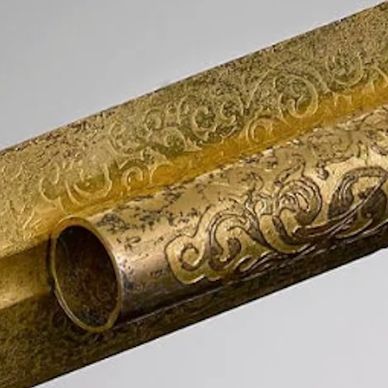
Also around the mid 1850s Acid Etching was being used to "Engrave" firearms.
This almost always left a result which was course and certainly not fine.
Laser Engraving
Combination Laser engraving with hand touch up Engraving.
Combination Laser engraving with hand touch up Engraving.
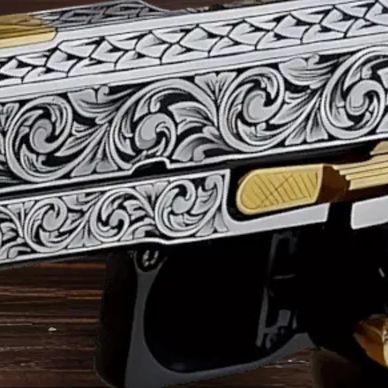
In the 1970s the first commercial laser engraving machines became available and since that time firearms have been engraved by laser.
The result is often bland and plain.
Combination Laser engraving with hand touch up Engraving.
Combination Laser engraving with hand touch up Engraving.
Combination Laser engraving with hand touch up Engraving.
In order to make laser engraving look more authentic, many companies, such as Italian shot Gun makers use a combination of laser engraving and then hand chisel some fine lines into the pattern.
To the inexperienced this can look like high quality hand engraving.
Houllier & Blanchard 1851 London World Fair

1851
This set of cased pistols won an award for Houllier & Blanchard when displayed at the London World Fair in 1851.
Uniquely, they are Gold and Platinum inlayed then engraved over the inlays.

Houllier & Blanchard 1851

Houllier & Blanchard 1851
Houllier & Blanchard took Engraving to a new level when they produced this cased set for the 1856 London World Trade Fair.
The Engraving was filled with Gold and Platinum and is referenced by Dr. Jack Ogden the leading British jewellery historian, author and publisher in his book on the use of platinum in jewellery the 19th Century.
Houllier and Blanchard not only engraved the firearms but also the ebony stocks.
They also engraved and placed brass inlay in the case in very fine detail.

Examples of hand engraving by Master engravers
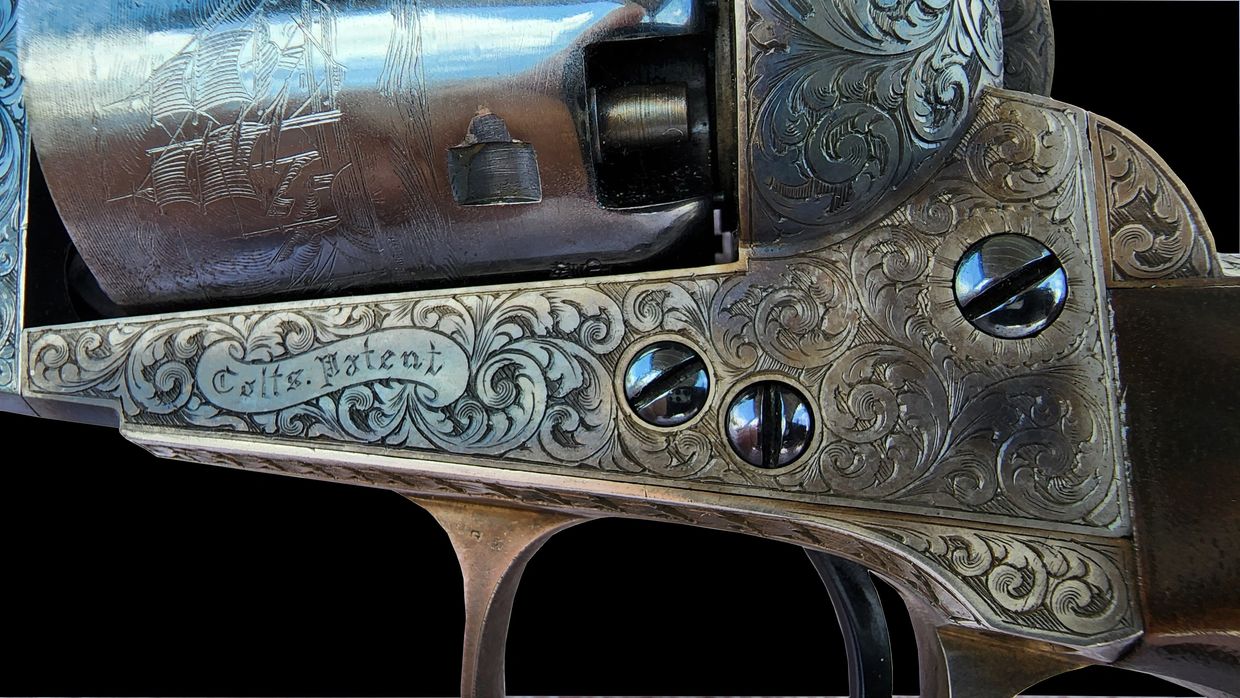
1853 Colt Navy Revolver - London production
Colt was certainly innovative in design but his factories produced employed some of the finest Master Engravers of the time.
In the US some of these are noted and recognised as the finest engravers, Young and Nimschke however by comparison comparison London engravers never signed their work and disappeared into obscurity.
However London Colt Revolvers engraved in the London deluxe Pattern are considered superior quality to Young and Nimschke
Colt was one of the first to use "Roll Stamp Engraving." commercially on Firearms.
Jacob Perkins invented this form in 1804
The two imaged below are of roll stamped engraving on a colt 1853 Navy revolver. and show in detail the results with one image under microscopic magnification.In the US some of these are noted and recognised as the finest engravers, Young and Nimschke however by comparison comparison London engravers never signed their work and disappeared into obscurity.
However London Colt Revolvers engraved in the London deluxe Pattern are considered superior quality to Young and Nimschke
Colt was one of the first to use "Roll Stamp Engraving." commercially on Firearms.
Jacob Perkins invented this form in 1804
The two imaged below are of roll stamped engraving on a colt 1853 Navy revolver. and show in detail the results with one image under microscopic magnification.
Our selection of antiques includes rare and one-of-a-kind pieces from different periods, including the Renaissance, Baroque, and Rococo. We source our items from all over the world, and we only choose the best quality pieces for our customers.
We offer a range of services to help you make the most of your antique experience. Our team of experts can provide you with appraisal services to determine the value of your antique items. We can also help you with restoration services to bring your antiques back to life.
Beckwith London

around 1840
1900 Rurope
late 1900 - Factory production of master engraving has diminished
The evolution of differing methods of decorating the metal work on firearms over the years, has progressed through an initial stage of casting in canons to hand engraving to roll stamp engraving, to acid etch engraving, to laser engraving and in recent times a combination or sometimes all of the above,.
The art of the hand engraving by a Master Engraver has disappeared from commercial firearm production.
Certainly some factories still offer some forms of "Engraved" factory production but mostly in basic form and a combination of laser.
Many factories still do offer custom engraving and the firearms are sent out to recognised artists.
But the days of fine works by the like of Factories like Colt and CZ with in house master engravers are gone.

Lacouture &b Lyon
France - 1840 - 1850 with multiple Damascus Barrel
Antique Pistols has been in the antique business for over 25 years. We started as a small family-owned shop in the countryside, and have since grown
Colt Brevette
1860
Colt London
London 1853
Colt London
London 1853
Colt London
London 1853
The Cardinal Knife
