A Copy Pistol from 1830

1834
Copy, pretend or counterfeit guns have been around for centurys.
This piece arrived in Hobart and was part of the George Rex collection.
George Rex arrived in Van Deman's Land on the 'James Harris' on 19th March 1834. and set up a chandlery in Hobart.
A number of his guns were passed down through family members
It would be fair assume this was sold to a crew member along the way on some dark drunken night while he was staggering back to his ship.
I am sure in the morning light he would have been very disappointed.
The ram rod under the barrel is not real and is just carved into the wooden stock,
Many antique gun is often described as 'never fired' ....always unlikely as they had to be fired to get proof stamped, however in this case you can be sure this has never been fired.
Not only has it no proof marks, the barrel is just under 2mm thick and would have exploded at the first attempt.
A reminder of just one of the traps and the hardship faced by early arrivals to Australia.
A bit like buying a cheap iPhone outside an Asian Airport today and getting home and finding out it is just a copy.
The Antique Pistols Experience

Different engraving
If we consider the upper image then there are a lot of considerations and aspects that come into play.
This antique pistol is a beautiful and excellent piece of Master Engraving.
In fact it looks too good.
So a closer inspection is warranted.
A.
The background is not uniform which indicates it is done by hand... that is a plus
B.
The sides of the excavation are so smooth for antique hand engraving which means it could have been engraved with a pneumatic engraving tool which leaves a smooth line of micro marks, not rugged as seen in the image on the right.
This tools was only developed long after 1901.... that could have been a concern but on closer inspection the engraving is just very finely done.
If you look closely into the corner turns around the leaf edges you can see the hand engraving.
This engraver, unknown, was a true master engraver.
C.
The wood is ebony and in perfect condition and engraved, or carved. Ebony is an expensive and rare material that would not appeal to the buyer wanting a pretend antique firearm to evade gun laws .
D.
There are numerous engraved marks that have defiantly been hand engraved and are part of the total engraved Pattern
In this case it was easy to confirm that it is a genuine antique.
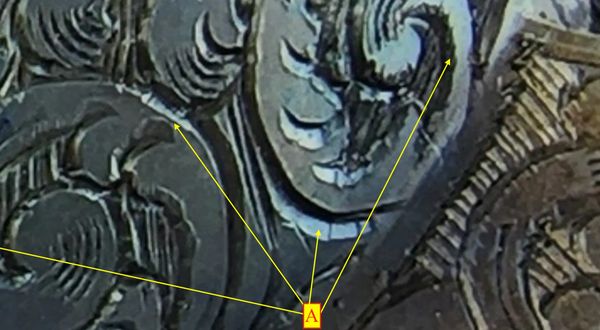
Under the Microscope
This engraving is magnified many times and looks very rugged, even unsightly.
In normal view, these jagged edges can not be seen and it is the work of a Master London Engraver.
Both images are of genuine antique engraving and can demonstrate the vast difference in style and result.
The antique pistol above was the subject of a very long investigation as the two revolvers in this set were advertised by a well known international firearm dealer as copy Colt Navy Revolvers possible made in the 1960 - 1970 era by a pair of well known copy gun makers.
The investigation revealed that not only were they genuine original factory production, some of the deformed tools ( Serial No. Stampings) used were forensically perfectly matched to some of the most famous guns in history, including one made and presented by Colt to Napoleon III and another made for the King of Italy and another made for Lord Cardigan.
The engraving played an major part in the confirmation as these indisputable deformed serial numbers were stamped over the engraving confirming they were factory engraved.
The process for engraving was and still is the metal was passed to the engraves in raw soft form.
After the engraving was completed, the Serial No.s were then stated into the soft metal.
The the parts were returned to production for hardening, and or case hardening, blueing or silver plating as the item required.
The fact that some of the engraving was stamped over by the deformed serial number tool, No. 9 in this case, confirmed the authenticity of genuine factory production and factory engraving.
An interesting report on the investigation and result of these Colt Navy Revolvers can be seen on www.coltnavypistols.com